
Showing posts with label Saudi Arabia. Show all posts
Showing posts with label Saudi Arabia. Show all posts
Wednesday, September 26, 2012
Gratuitous Camel Pictures


Monday, September 24, 2012
Searching for the Edge of the World: Part 1
Yes, I am aware that it is 2012 and we know the world is round. The Edge of the World is an amazing place in Saudi Arabia. Blue Abaya wrote a great post with pictures about this amazing site. Saudi National Day was on September 23rd and the King decreed that we should have Saturday off as well. (I know, Saturday and Sunday are the weekend, right? Well, in Saudi Arabia, our weekend is on Thursday and Friday).
When you have a four-day weekend, you have to do something fun, right? Of course! Fortunately, ex-pats are wonderfully flexible and spontaneous. We asked some friends if they had plans on Saturday and they said they were open to suggestions. We decided to find the Edge of the World together.
From experience, we've learned that going to the desert in a group is wise. Within a few minutes, we had a group of families willing and able to go to the desert. On Saturday, we met at a mall, where I stared at the never-ending construction taking place around Riyadh. Once all the cars were gathered, we were off, headed north out of Riyadh.
 We drove past some tent cities. There aren't really tent cities but there are a lot of old, run-down tents gathered in small sections of the desert. If you've ever been on the Wind River Indian Reservation in Wyoming, you find that the two areas are very similar.
Eventually, we passed the tent villages and came to a small village. After driving through the village, we passed a plantation of date palms and fields with green crops growing. We even passed two men on a donkey cart, being pulled by a donkey.
Once past the fields, things were pretty deserted. We drove for awhile and then turned off the main road onto a dirt/gravel/sand track. At this point, the men started to grin and show off a bit. I don't know why, but men really get a kick out of driving on roads like this. The kids loved the bumpy track and enjoyed bumping along.
Soon we started to see camels grazing around Acacia trees. A camel herder riding a donkey wandered around, keeping an eye on the camels, and, I imagine, the strange foreigners who kept gawking at his camels.


I enjoyed looking at the trees and vegetation, sparse as it was. The ground was hard and rocky in places, and then in other places was like gravel quicksand.

We drove along a very hard track where the landscape was completely barren without even the slightest bit of scrub brush. After driving this track for a while, we stopped and assessed our situation. We hadn't found the destination, but everyone was hungry. We set up rugs and blankets on the hard, rocky surface that was totally exposed to the sun and wind. There wasn't anything available for shade. The kids were happy to be out of the car.


So this little boy couldn't hold it anymore and goes in this bathroom. On the way home, he decided to LICK his shoe. Who knows why a boy of 5 decides to lick his shoe following a visit to a really foul toilet facility, but he did. The next day he was SO sick, with a fever and everything.
We later learned from a friend who had been several times to the Edge of the World that the path has changed and even he couldn't find it. I wonder if the authorities have decided to close off the path for visitor access.
When you have a four-day weekend, you have to do something fun, right? Of course! Fortunately, ex-pats are wonderfully flexible and spontaneous. We asked some friends if they had plans on Saturday and they said they were open to suggestions. We decided to find the Edge of the World together.
From experience, we've learned that going to the desert in a group is wise. Within a few minutes, we had a group of families willing and able to go to the desert. On Saturday, we met at a mall, where I stared at the never-ending construction taking place around Riyadh. Once all the cars were gathered, we were off, headed north out of Riyadh.
 We drove past some tent cities. There aren't really tent cities but there are a lot of old, run-down tents gathered in small sections of the desert. If you've ever been on the Wind River Indian Reservation in Wyoming, you find that the two areas are very similar.
Eventually, we passed the tent villages and came to a small village. After driving through the village, we passed a plantation of date palms and fields with green crops growing. We even passed two men on a donkey cart, being pulled by a donkey.
Once past the fields, things were pretty deserted. We drove for awhile and then turned off the main road onto a dirt/gravel/sand track. At this point, the men started to grin and show off a bit. I don't know why, but men really get a kick out of driving on roads like this. The kids loved the bumpy track and enjoyed bumping along.
Soon we started to see camels grazing around Acacia trees. A camel herder riding a donkey wandered around, keeping an eye on the camels, and, I imagine, the strange foreigners who kept gawking at his camels.


I enjoyed looking at the trees and vegetation, sparse as it was. The ground was hard and rocky in places, and then in other places was like gravel quicksand.
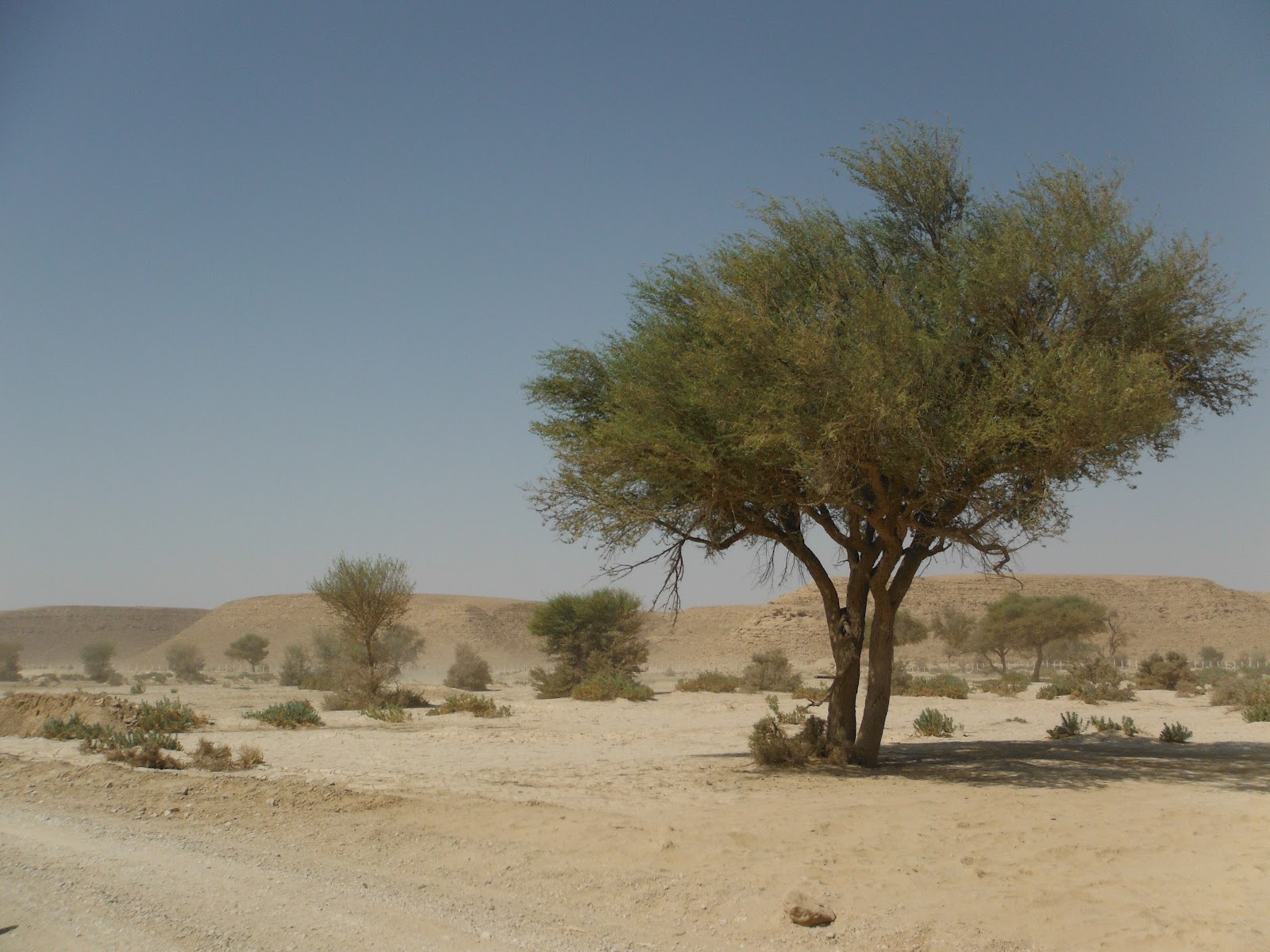
Our caravan found a track, drove down it until we found that the track was washed out. While we all had four-wheel drive vehicles, we simply couldn't get past some of the barriers. So we turned around and tried a second path, which led nowhere. Finally a third path looked interesting.
We drove along a very hard track where the landscape was completely barren without even the slightest bit of scrub brush. After driving this track for a while, we stopped and assessed our situation. We hadn't found the destination, but everyone was hungry. We set up rugs and blankets on the hard, rocky surface that was totally exposed to the sun and wind. There wasn't anything available for shade. The kids were happy to be out of the car.
After lunch, we decided to explore the area for a bit. There was a path down a cliff that looked promising. My kids tromped down the path with their dad. They are pretty intrepid explorers. T found several fossils. In fact, the whole area was very interesting. T gave us a lecture (he is SO his mother's child) about water and wind erosion and claimed that the area showed evidence of water erosion.


Following this short hike, we decided we had better go back home and try looking for the Edge of the World another day.
On our drive back, my husband noticed that one of the cars was leaking something, which turned out to be transmission fluid. One of the other cars towed the car with the leaking fluid while we drove ahead to the small village to find out if they had a mechanic available to look at the car. We found a garage and they found a hole in the transmission.
While we waited for them to patch the transmission, the women and I chatted. Pretty soon all these men started walking around, staring at us because our hair was uncovered. We caused quite a stir. One of the little boys had to go to the bathroom, so his dad took him to the garage bathroom. Facilities can be SO primitive here and this place was really bad. This sounds awful, but it is even worse because a lot of immigrants with horrible hygiene work at these places. Now imagine the most disgusting bathroom you've ever encountered at a gas station, and then imagine it 100 times worse. These toilets are holes in the floor with a place for your feet. The floors are disgusting with all sorts of yucky stuff on the ground.
So this little boy couldn't hold it anymore and goes in this bathroom. On the way home, he decided to LICK his shoe. Who knows why a boy of 5 decides to lick his shoe following a visit to a really foul toilet facility, but he did. The next day he was SO sick, with a fever and everything.
Finally, the car got fixed and we drove to my husband's outdoor office where we women availed ourselves of more modern toilet facilities. Then it was back home to Riyadh.
We later learned from a friend who had been several times to the Edge of the World that the path has changed and even he couldn't find it. I wonder if the authorities have decided to close off the path for visitor access.
Friday, August 24, 2012
Hagar
I recently read this post from the blog, Women in the Scriptures, about Hagar, the concubine/wife of Abraham, and mother to Ishmael, the father of the Arabic nations. When I was growing up, I never gave Hagar's story much thought--though I did think she was treated pretty unfairly. Since moving to Saudi Arabia, I've read the book of Genesis three times and have spent more time thinking about Hagar and the significance of her story.
I think Heather did a wonderful job discussing Hagar's story. Enjoy her insights!
I think Heather did a wonderful job discussing Hagar's story. Enjoy her insights!
Thursday, August 9, 2012
Strange But True Things About Life in Saudi Arabia
So its been awhile since I've posted about life here in good ol' KSA. Here are some strange, but true things about this country that aren't necessarily worth a whole blog post on their own, but as a group, count as a whole post. This post was compiled with the help of my oldest son, who is 12 years old.
1) There are probably more Krispy Kreme stores/kiosks per capita in Riyadh than any city in the USA. I don't have any data or statistics that would back me up. But judging by the number of Krispy Kreme kiosks in just one mall, I don't mind making that claim.
2) Malls are weirdly quiet here. Stores don't blare competing and annoying music. And the people don't talk very loudly.
3) The sanitary disposal bins in women's bathrooms are marked with a tampon symbol, but as far as I know, you can't buy tampons in KSA. Don't ask me why because I have no idea. (ETA: Yesterday I was at the pharmacy at the Hayat Mall and found they had a few boxes of tampons. This is the first time I have ever seen tampons at a pharmacy or grocery store. Still, I don't think you can buy them everywhere.)
4) There are corn-in-the-cup stands all over--and potato-on-a-stick. Saudis like their corn and potatoes.
5) They have stores called Pizza Inn and Taco Hut.
6) If the fast food restaurants get run out of business in the U.S. from all the outrage about transfast and other stuff, they'll be fine because they have a firm foothold in KSA.
7) The main entertainment choices for people seem to be either malls or food.
8) Bookstores don't usually have very many books--and the books that are available seem to mostly focus on the Koran. My son pointed out that one bookstore sells more office supplies than books.
9) You can buy an ipod case at pet stores.
10) You can buy dyed chicks at pet stores. (This just makes me sad.)
11) Kiosks are more common than vending machines.
12) Water is insanely cheap. I think artificially so. It usually costs 1 riyal for a bottle of water, which is about 33 cents.
13) This one comes from my son--you can find cutting edge technology and old technology really easily, but finding the stuff in between is hard.
14) The arctic wolf is an endangered animal in Saudi Arabia.
15) There are baboons living in the desert.
16) During Ramadan, our compound has shopping buses that go out from 8:45 PM to 11:45 PM. Yes, you read that right. I thought it was a typo at first, but the malls stay open very late at night during Ramadan.
Monday, July 9, 2012
How to Adapt to Living Abroad: Part 1
One comment I frequently get from family, friends, and acquaintances about living abroad is that I must be so brave. Honestly, the comment puzzles me because I don't feel particularly brave. Granted, I enjoy living in different countries. I find it exciting and stimulating. But I also think that there are skills you can develop to help you enjoy the experience. Here are some of the skills I think are essential to not only survive in a foreign country, but thrive.
1) Accept that life will be different in a foreign country.
I know it sounds silly to say that because you probably all know that. But understanding that on an intellectual level is not the same as accepting it. Life in a foreign country does not have to be the same as your home country to be good. You will experience differences all the time. You have a choice when you acknowledge those differences. You can allow those differences to oppress you or you can acknowledge them, adjust to them, and move on with your life.
2) Accept that you can dislike (even hate) things about the foreign country, but still enjoy living there.
There were things that drove me crazy about Sweden. But I loved living there. The same can be said for Saudi Arabia. There are some things that disturb me deeply. But regardless of those issues, I still like Saudi Arabia. I guess I can still enjoy life in Saudi Arabia because I know my time here isn't permanent.
3) Take the opportunity to explore the country, learn some history, and learn some of the culture.
You need context when you live in a foreign country. Cultural practices which can be very baffling make more sense when given context. For instance, while I don't love wearing the abaya, understanding the context behind it--religious, historical, and cultural, at least gives me some background. Sometimes things about Saudi culture seems so contradictory and confusing. It helps me immensely when I place those confusing things in the scope of the short history of the nation of Saudi Arabia (which is actually a relatively new country--though a very old culture.) Consider this: in your own country there are things that would be difficult to understand if you didn't already know the context. You have to learn the context when you live in another country.
4) Try the local foods.
You don't have to try everything, and you most certainly don't even to have to like what you try, but do TRY some of the local foods. Local foods actually tell a lot about a country's history and culture. For example, many of the food traditions in Sweden stem from religious practices during the Middle Ages. When Sweden changed from Catholicism to the Lutheran church, they still retained many of the food traditions. When I eat pea soup with pancakes on Thursday, I'm actually eating a bit of history and culture. The same can be said for food in Saudi Arabia. The food reflects the agriculture, trading, and historical practices of the region. Even the food in the U.S. reflects interesting things about our culture: the multi-cultural nature of the country, historical practices that stemmed from huge social changes following World War 2, and the role that big corporations play in our diet.
So consider trying the local food as a means to understand the culture better.
I'll continue this series in later posts.
What skills have you developed traveling or living abroad? What do you think is essential to not only surviving but thriving in a different country?
Subscribe to:
Posts (Atom)